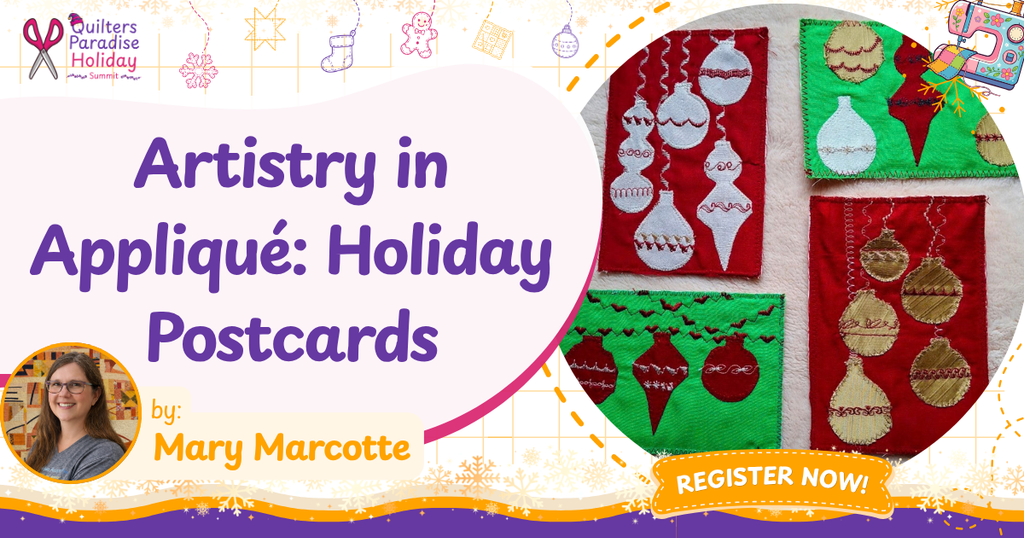
Click the photo below to register for the free Quilters Paradise Holiday Summit. I have a session on the Friday of that week.
I have a screaming pet-peeve. Our guild is small, with only about 25 people. I would guess that almost half are new to the guild and half of those are new to quilting. I love teaching and have a big personality. When those combine, someone is learning something before we go home. Forgive me for being bold and caring about other people, because that is truly how I think of it. I’m helping. Hopefully I’m not overdoing it, but that may occur if I’m really excited about something, like improv.
That means I now know a few of our new quilter members. One, let’s call her Donna, confided in me that she has a quilt pattern she’s struggling with. Donna was hoping to come over so I could help her decipher the instructions.
Now, I won’t disparage someone who is trying to make a business by creating and selling patterns. But I will tell you that if you buy a pattern that you love and you can’t decipher it, one of two things is happening. You are not ready for a detailed pattern or there is nothing on the pattern that hints at the level of difficulty. In this case, both were true. My young friend is not ready, but the pattern does not state that it is meant for an advanced intermediate to experienced. How could Donna know? With that knowledge, she had options. Without it, she had frustrations. So the question is who is responsible for this mistake?
And so, this is my current pet peeve: a professional writer includes all the information a person needs to complete the task. Period. That applies to all instructions. Any writer who does not do so is not a professional writer. Can one pattern get published with missing information? Absolutely, but then you find a way to make it right. Give your customer an opportunity to come to you with questions.
This particular pattern also did not include a list of terms. Donna doesn’t know all the quilting jargon. Could she have gotten it online. Sure. But then there’s the problem of wading through terms you don’t need. A short list of terms with clear definitions does not take much time or space. A buyer can expect that it is part of the pattern. Besides, expecting your customer to find the answers you should provide proves that you are not yet a professional.
Finally, this particular pattern included directions for two quilts: a queen and a wall hanging. Explaining the order of information takes too long. Here’s a graphic:
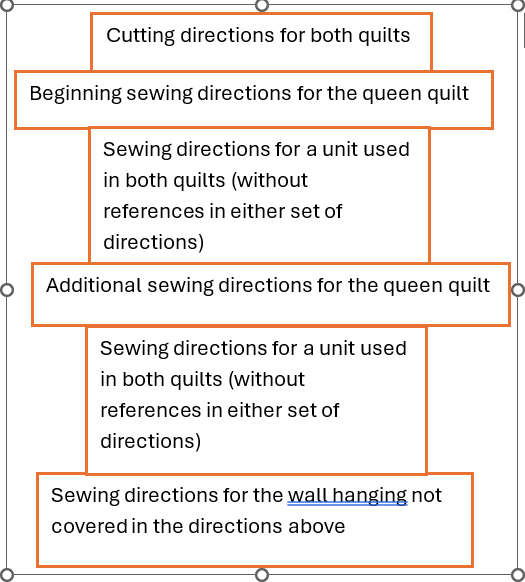
Maybe it’s the writing teacher in me, maybe it’s the pattern maker, maybe it’s just me. But this kind of pattern writing simply will not do. And relying on testers can have its downsides. Pattern testers are senior quilters, graduates from beginner and intermediate patterns. After a while, they understand the writer’s meaning and may not catch a questionable section. Regardless, not all quilters are seasoned. Few have experiences to rely on. Most struggle with patterns. Let’s give them a helping hand.
Without someone to decode the pattern, she may not have continued as a quilter, thinking she is incapable. However, she is capable when treated as an advanced beginner and given the information she needs.
I must say, I told her to never make a purchase from that brand. Not because I want to hurt the brand or writer, but because she deserves better.
What do you think? Have I exploded this pet-peeve into something that is really a non-issue? Should anyone look at a pattern, fall head-over-heels with it, yet be capable of determining whether it’s a good fit? Who is the responsible person: the writer or the buyer?